
West Memphis Directory Holdings
Only two West Memphis editions have firm, item-level confirmation in the reviewed sources. The St. Louis County Library genealogy inventory lists the 1958 and 1960 editions on microfilm. A National Register nomination for the West Memphis Commercial Historic District cites directory volumes across a 1930 through 1960 source span, yet that citation does not show that every annual issue survives or that one repository owns a complete run. Exact publishers, issue frequency, missing years, and the final printed edition remain research gaps.
| Collection | Years | Where Held | Access |
|---|---|---|---|
| West Memphis city directories | 1958 and 1960 confirmed | St. Louis County Library genealogy microfilm | Contact the library for film, scan, or loan rules |
| Directories cited by historic-district researchers | 1930 through 1960 cited as a source span | Repository not identified in the nomination | Trace the bibliography through WorldCat, local reference staff, and State Archives |
| Federal population census | 1850 through 1950 public for relevant Crittenden research; 1890 largely lost | NARA, FamilySearch, and library databases | Online or library access varies by provider |
| Crittenden deeds, marriages, and probate | County-era books; exact film spans vary | County clerks, State Archives, and FamilySearch catalog | Catalog, office counter, and some restricted digital images |
The Arkansas directory inventory is the clearest published lead for the two confirmed reels.
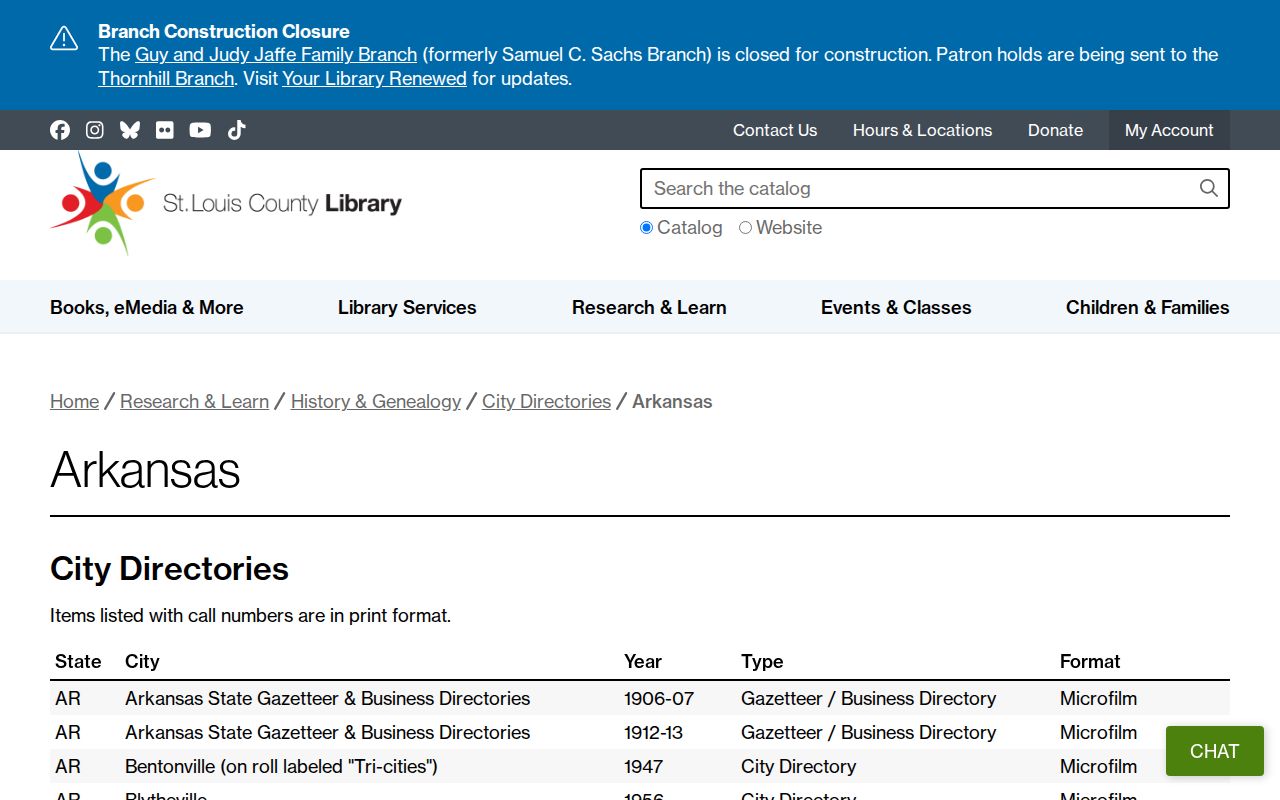
The captured inventory gives researchers a firm starting point without turning the broader 1930 through 1960 citation into an unsupported claim of annual coverage.
West Memphis Library Search Routes
The West Memphis Public Library and Innovation Center at 500 E. Broadway offers reference help and interlibrary loan. Its published pages do not provide a directory-year shelf list, a named local-history room, or a verified obituary index. Call 870-732-7590 and ask staff to check by title, year, publisher, call number, and format. A precise request should also ask whether an edition includes a reverse street section, a householder index, and an abbreviation page.
The official library page shows the local service point researchers can contact.
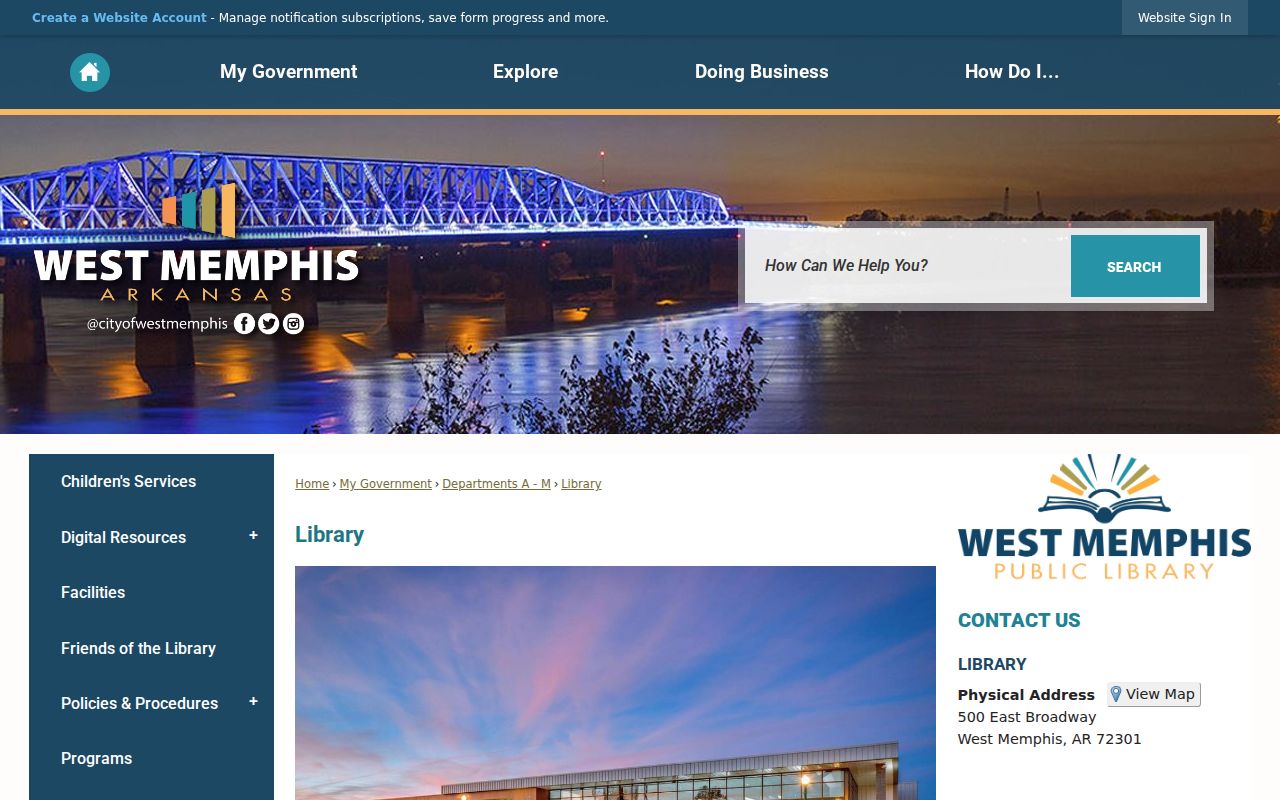
The library is the first local fallback when a catalog search produces no exact volume because staff can check shelves, closed stacks, reference files, and interlibrary loan.
Its Polaris catalog supports Keyword, Browse, Phrase, Exact, Advanced, and Boolean modes, plus a “Limit by” control. Try “West Memphis,” “Crittenden County,” “city directory,” “yearbook,” “newspaper,” and a family surname as separate searches. Do not assume a blank catalog result means no item exists. Local material may have a broad title or only a county-level record.
West Memphis Genealogy Access
The library’s General Resources page confirms HeritageQuest access with a library-card number. That service can help bridge a directory find to census and family-history records. Ancestry Library Edition, a local obituary database, and an itemized genealogy collection were not confirmed in the reviewed local pages. Researchers should ask before making a trip or depending on a named database.
The library genealogy resources page documents the verified card-based option.

The screen supports a practical two-part method: search the dated directory first, then use census and family records to test the name, age, kin, and place clues.
For a county-level fallback, the FamilySearch catalog includes Crittenden deeds from 1826 to 1900 and surname indexes through 1938. Some images may require a login or affiliate center. The Arkansas State Archives is another place to request collection-level inventories for newspapers, county records, and related film. Ask for a citation or catalog record before treating a collection as confirmed.
Note: A library subscription confirms access to a research service, not the presence of every West Memphis directory edition.
Read West Memphis Directory Entries
No digitized page from the confirmed local reels was available for inspection. The inventory below describes fields to check in a mid-century volume, not verified West Memphis typography. Photograph the title page and abbreviation key before copying an entry. Then preserve punctuation and symbols exactly. A mark that means homeowner in one publisher’s book may mean something else in another.
| Name | Surname, given name, and middle initial as printed |
|---|---|
| Household clue | Spouse in parentheses or a widow notation, if the local publisher used it |
| Occupation clue | Printed occupation, title, business, agency, or institution abbreviation |
| Location clue | Residence marker, house number, street, and possible business cross-reference |
| Status marks | Possible owner or renter symbol, telephone listing, and other publisher codes |
A sample inventory should state the volume, page, and key used to decode the line. Without that check, a generic convention must remain a hypothesis. A listed address is evidence tied to the publication date, not proof of continuous residence or ownership.
- Criss-cross directory
- A section arranged by street and house number rather than by surname. Its presence in the local reels has not been verified.
- Householder index
- A listing centered on the person associated with a household, often used to shift from an address to a name.
- Abbreviation key
- The publisher’s own legend for residence marks, occupations, firms, and status codes. It controls how that volume should be read.
West Memphis Directory Time Bridges
West Memphis developed well after Crittenden County was created in 1825, so the earliest local people may appear under county precincts or rural communities. Public federal census schedules now run through 1950, while the 1890 population census is largely destroyed nationwide. The confirmed directory reels sit in the useful post-census gap.
| Time marker | Research meaning |
|---|---|
| 1825 | Crittenden County formed; early deed, tax, probate, and marriage records precede West Memphis city series. |
| 1890 | The missing federal population schedule makes deeds, tax lists, probate, newspapers, and later directories more important. |
| 1950 | Newest public federal census provides the last full household schedule now open. |
| 1958 and 1960 | Confirmed West Memphis city directory reels can bridge names and addresses after that census. |
No verified first directory year, publisher-change chronology, or last printed year was found. Those gaps should be recorded in research notes, not filled with estimates.
West Memphis Directories as Evidence
The Commercial Historic District nomination cites West Memphis directories spanning 1930 through 1960 to connect downtown buildings with proprietors. That is strong proof that historians used directory evidence across those dates. It is not proof that every year was issued, survived, or sits in one archive. This distinction matters when a family appears in 1958 but not in an assumed 1959 volume.
The downtown context can also help decode a terse employer abbreviation. City history describes 8th Street as “Beale Street West” during the 1930s through 1950s and places an early B.B. King performance at Miss Annie’s Place, also known as the Square Deal Café, on South 16th. GROW West Memphis 2040 describes a 1938 industrial scene with lumber, cottonseed-oil, cotton-gin, compress, feed-mill, distillery, and ice-plant firms. Such context guides research, but it never replaces the printed entry.
Map West Memphis Directory Addresses
The Library of Congress Sanborn collection adds building form and use to a printed-directory address. It holds West Memphis sets dated August 1930 with two sheets, November 1938 with six sheets including Hulbert, and June 1949 with sixteen sheets including Hulbert. These images show structures and land use, not residents. Pair the map sheet with a directory line rather than reading an occupant into the map.
Use the Crittenden County FamilySearch catalog to locate supporting record groups.
The catalog view can move a directory clue into deeds, probate, marriage, or other county material, but digital-image access may depend on account or affiliate-center rules.
Street renumbering dates and a formal West Memphis renaming chronology were not found. Search directional prefixes, street types, old place names, and the legal description when a modern address fails. The parcel or lot-and-block description can remain stable after a postal label changes.
Trace West Memphis Households
A careful city directory search works one dated source at a time. It separates what the book printed from conclusions drawn later. Keep a small log with edition, page, exact entry, address, variants, and the next record checked.
- Start with the directory year closest to the known event. Search surname variants, initials, and the street section if the volume has one.
- Copy the full entry and the abbreviation key. Record spouse, work, telephone, street, and each mark without expanding uncertain codes.
- Move one available volume forward and one backward. Note each appearance, absence, name change, or shift of address.
- Pair 1950 census evidence with the 1958 and 1960 directory lines. Use deeds to test ownership and probate or obituaries to test a death or heir trail.
- If the run breaks, ask the local library, Arkansas State Archives, and WorldCat for the precise missing title and year. Record a negative result.
A disappearance may reflect a move, death, marriage, publisher omission, annexation, or altered street label. No single cause should be assumed. If the goal shifts to modern ownership keyed by an address, the West Memphis street directory workflow keeps that separate from the historical shelf.
West Memphis Archive Fallbacks
When the target volume cannot be found online, use the access channels in order: search the local Polaris catalog, contact the library reference desk, request interlibrary loan, inspect WorldCat, ask the Arkansas State Archives for a collection inventory, and then check FamilySearch catalog access. For an exact 1958 or 1960 citation, contact the holding library about its microfilm policy. For broader 1930 through 1960 claims, ask the historic-district nomination’s bibliography where the cited copies were consulted.
Yearbooks, newspapers, probate, deeds, marriage records, and census schedules are companions, not substitute city directories. Nearby Memphis collections can supply regional context, but their strongest described holdings concern Memphis and Shelby County. West Memphis remains in Arkansas and Crittenden County. A regional hit across the river must be tested against the proper Arkansas custodian.
Note: No complete local shelf run, verified publisher list, reverse-section inventory, or last printed West Memphis edition was located.